Since its founding, A&D HOLON Holdings’ business has been built upon the “measurement” technologies that it has cultivated and advanced over many years.
Our “measurement” technologies consist of “fundamental technologies” common to all three business segments and “solution technologies” that help solve our customers’ challenges.
Moving forward, we will continue to focus on “HONMONO” authenticity and drive innovation while perfecting our “measurement” technologies, and strive to create value that supports the world.
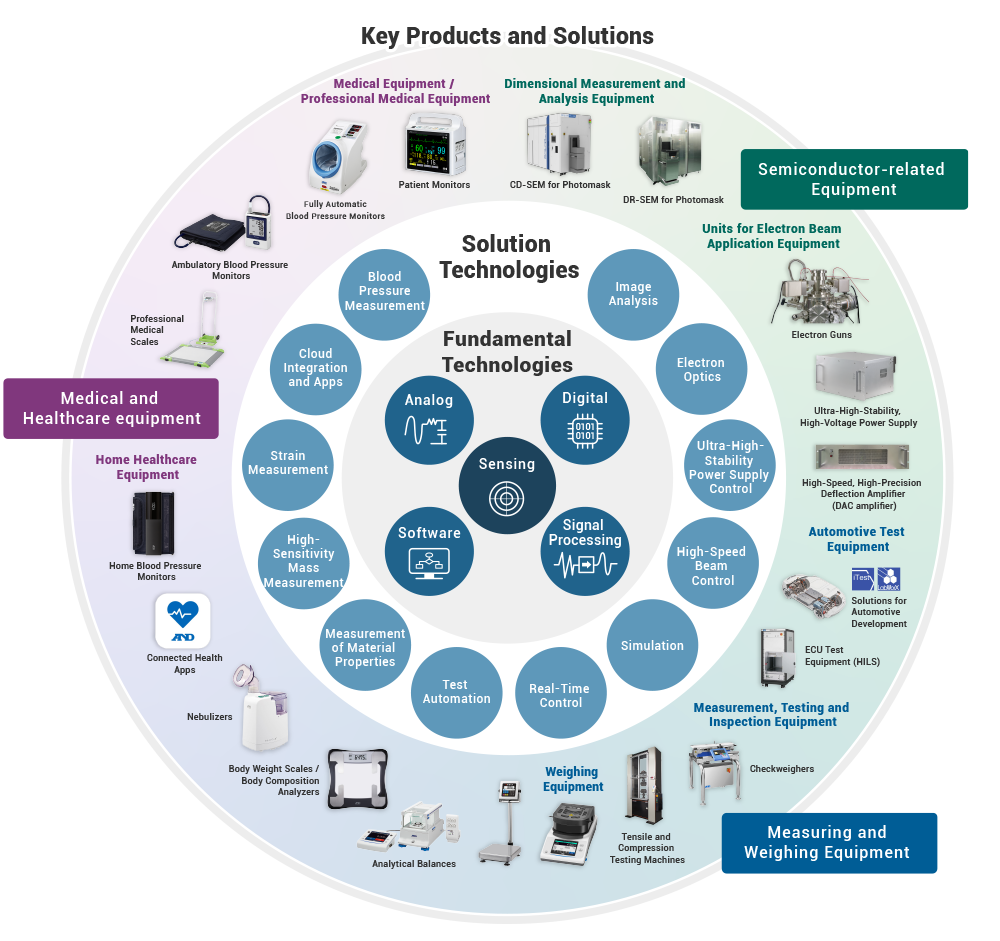
Fundamental Technologies
Sensing Technology
- Technology that converts real-world physical phenomena into electrical signals with high precision and at high speed
- A fundamental concept at the core of “measurement” technology and a key factor that determines measurement accuracy.
- The core of this technology lies in extracting the true signal from an analog signal that contains noise and converting it to digital form.
- By utilizing multiple principles—such as strain gauge, electromagnetic force restoration, and pressure sensor methods—it is possible to design the optimal sensing method tailored to specific applications and accuracy requirements.
- Usage Examples:
・ Sensing weight, force, and strain using strain gauges. (Platform scales, force sensors, and body weight scales)
・ Weight sensing using electromagnetic force restoration principle (Electronic balances, high-precision weigh modules for integration into production lines)
・ Pressure sensing using pressure sensors (Home blood pressure monitors, blood pressure monitors for medical use)
Analog Technology
- Technology for handling analog electrical signals with high precision to ensure accurate measurement and control
- Capable of stably processing a wide range of signals, from minute voltages and currents to high voltages
- Design technologies that ensure long-term stability, such as noise reduction and resistance to temperature fluctuations
- A/D and D/A conversion technologies provide a high-precision interface with digital technologies.
Digital Technology
- Technology for the high-speed and stable processing and transmission of signals acquired through sensing and analog technologies
- Enables high-speed processing and highly reliable transmission of digital signals
- Capable of high-speed digital circuit design that take into account clock design, timing control, and noise immunity
- Supports various interfaces, such as PCIe, USB, and Ethernet
- System design is possible across a wide range of platforms, from microcontrollers to CPUs and FPGAs.
Software Technology
- Technology for controlling hardware efficiently and in real time
- Supports a wide range of environments, from ultra-compact microcontrollers to high-performance CPUs
- Capable of utilizing a wide range of development tools, from assembly language to Java and web technologies
- End-to-end software development structure, from embedded control systems to cloud-based data management and visualization.
Signal Processing Technology
- Technology for processing and analyzing acquired digital signals by converting them into the appropriate format for the intended use
- Single signal processing, such as noise removal, frequency filtering, and FFT
- Supports transfer function analysis and correlation analysis involving multiple signals
- Applies appropriate actions to the target through control using inverse transfer characteristics (feedback and iterative control)
- Statistical analysis and AI technologies for applications such as anomaly detection, predictive maintenance, and classification
Solution Technologies
Image Analysis
This technology extracts features and information from image data to recognize and evaluate objects. By leveraging AI and image processing technologies, we have achieved high-precision analysis and automation of SEM (Scanning Electron Microscope) images used to observe the fine patterns on semiconductors.
In addition, pattern-matching technology enables highly sensitive detection of minute differences and defects. This reduces measurement variability and enables early detection of defects, thereby contributing to improved quality and productivity in semiconductor manufacturing.
Electron Optics
This technology treats electron behavior in a manner similar to light and uses electric and magnetic fields to control and focus them; it is utilized in photomask dimension measurement and defect review systems (Mask CD-SEM/DR-SEM). Electrons have extremely short wavelengths compared to light, so it is possible to observe nanoscale structures—which are invisible under an optical microscope—with high resolution. The shape and position of the electron beam are controlled with high precision by electron lenses. This enables advanced observation and measurement of increasingly miniaturized semiconductor devices, contributing to the resolution of process-related challenges and the improvement of product quality.
Ultra-High-Stability Power Supply Control
This technology achieves extremely high output stability in high-voltage and constant-current power supplies used in semiconductor inspection and lithography systems. Thanks to its ultra-high stability and ultra-low ripple noise design, it minimizes electron beam fluctuation and maximizes inspection and lithography accuracy. We meet equipment manufacturers’ demands for high reproducibility and long-term stable operation, and we also provide design solutions tailored to individual specifications as well as support for safety certifications. By paying meticulous attention to design down to the component level—including the use of carefully selected, high-precision parts—and continuously striving for industry-leading stability, we contribute to improving the quality of semiconductor manufacturing.
High-Speed Beam Control
This is a technology used in semiconductor inspection and lithography systems that enables the positioning of an electron beam in an extremely short amount of time. It achieves both high speed and stability by combining a deflection control amplifier (DAC/AMP) to enhance response performance with wiring that minimizes noise sources and a design capable of handling high voltages. This directly improves the throughput (processing speed) of our customers’ equipment and contributes to high-precision lithography and inspection.
Simulation
In addition to CAE design, we utilize technology that creates plant models of test equipment and test specimens to perform design and safety verification through simulation, thereby improving development efficiency and quality. Furthermore, we provide test equipment that combines simulation with real-world testing environments to support our customers’ product development.
Real-Time Control
This technology combines measurement and control technologies to precisely control a wide range of testing machines. By integrating with actuator and mechanical design, we achieve high-speed and high-precision testing through optimal control tailored to the characteristics of each machine.
Test Automation
Software-based technology to automate processes such as long-term testing, switching between processing modes based on test conditions, and quality assessment. Through a multi-layered protection design—including safety controls—and standardized operations, we achieve test automation and high reproducibility, thereby contributing to greater efficiency and improved quality in evaluation tasks.
Measurement of Material Properties
This technology evaluates material properties—such as strength and ductility—based on force measurements. By applying various forces to materials, the system measures properties such as tensile strength, compressive strength, shear strength, torsional strength, bending strength, and friction, and the results are utilized in research and development and quality evaluation.
High-Sensitivity Mass Measurement
This technology enables highly sensitive measurement of minute changes in mass. By combining a highly sensitive detection mechanism that utilizes a lever-type structure with precise electromagnetic force control, we achieve high-resolution mass measurements. It is used in various fields—such as research and development and quality assessment—where it is necessary to measure minute masses.
Strain Measurement
This technology captures the minute deformations (strain) caused by forces and loads—such as tension and compression—as electrical signals and measures them with high precision. By using strain gauges—which detect changes in electrical resistance—to convert the deformation of a load cell into an electrical signal, we can quantitatively measure force and mass. It is employed in products such as electronic scales and body weight scales, and is widely used in various industries ranging from household to commercial applications.
Cloud Integration and Apps
This technology enables the secure management and utilization of collected data in the cloud. We enable integration with external services and systems through applications and APIs, making it possible to utilize data regardless of location or device. It is used across a wide range of fields, from the medical sector to automotive testing, and supports data sharing and analysis across multiple locations. Furthermore, we focus on user-friendly UI/UX design, making measurement data collected from instruments easy to visualize and interpret.
Blood Pressure Measurement
This technology measures blood pressure by accurately detecting changes in pressure within the cuff. Blood pressure is determined by analyzing the minute pressure fluctuations associated with the pulsation of blood vessels using the oscillometric method. We have refined our blood pressure assessment algorithm based on findings from clinical trials and industry-academia collaborative research, enabling highly accurate blood pressure measurements. It is widely used in a variety of settings, from households to medical facilities.